
Seamless Gutters in Tulsa. Made on Site.
New seamless gutters in Tulsa are very important, just like a new roof. Guttering that drains properly carries the water away from the house. Guttering that overflows or stays clogged doesn’t. One protects your home and the other damages it.
I’ve been roofing since 1996, and Green Country Roofing has been in Tulsa since 2018. Roofing and gutters. That’s all we do. That means gutter installation across greater Tulsa: new seamless gutters in 5-inch and 6-inch, gutter guards, and repairs.
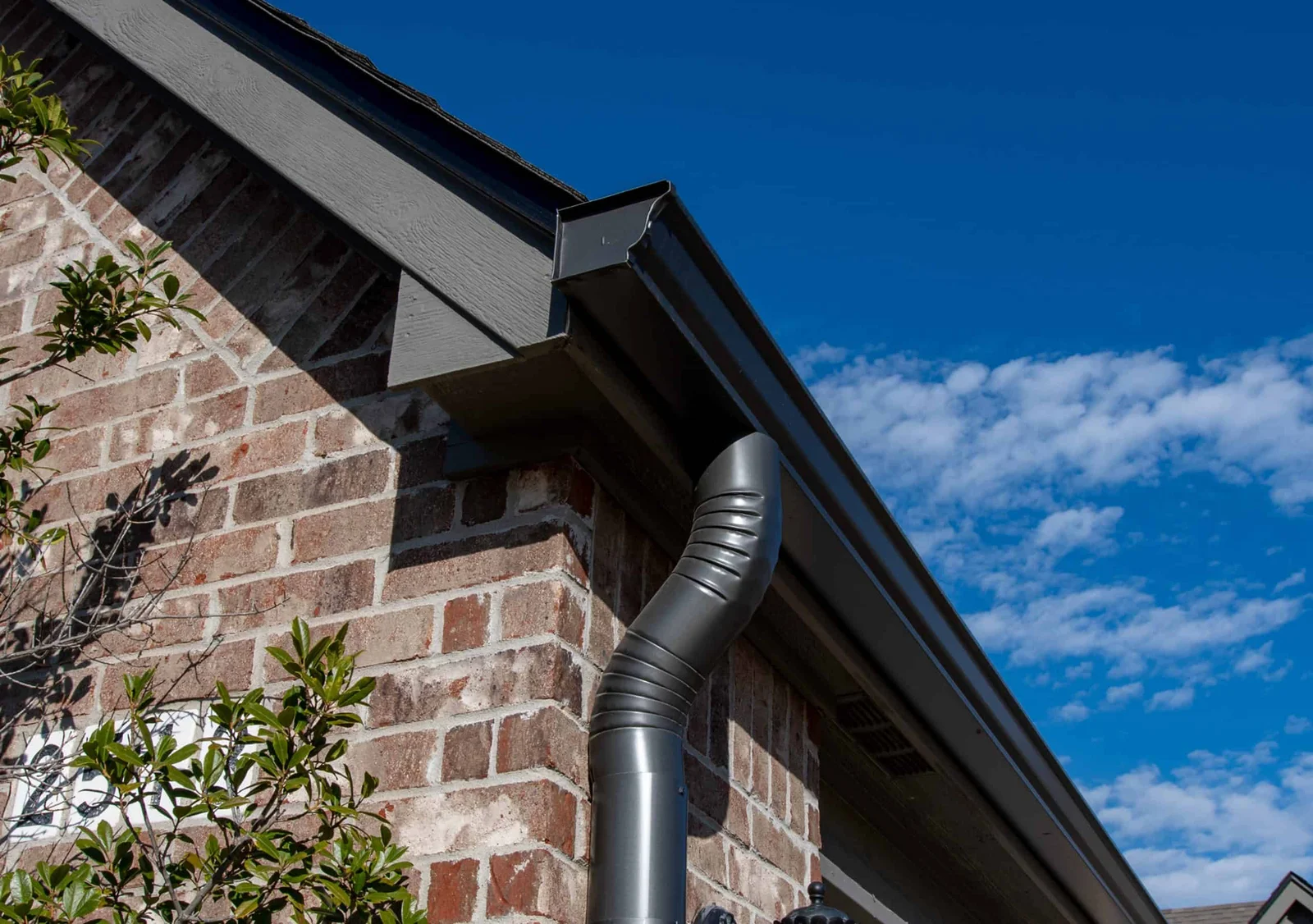
The complete page for homeowners Prices, sizes and guards Repair or replace
Control the water, then direct the water
Thirty years in construction and here’s the main thing about water and gutters. Water coming off the roof and landing on the ground erodes the dirt around the house and works on your foundation. Even the second story section should be looked at, water splashing on the shingles can wear them. Then get that water flowing the proper direction; maybe the front of the house grades better to the street. Control the water, then direct the water. Your house will love you.
Control the water, then direct the water.
All things guttering, the short version
Guttering that lasts is all about the details.
Seamless guttering is pretty simple and universal. But imagine using a longer screw that holds better. Or using an actual downspout outlet instead of folding the gutter downspout and calling that good enough. What about a stronger gutter hanger. These are what matter.
You can check your gutters, no ladder needed.
A few easy ways to check. Dark stains anywhere on the guttering, usually a sign of major overflow. Anything growing out of the top; it happens all the time. And the gap between the gutter and the fascia: even is good, closing at one end means sagging.
Sometimes a repair is all you need.
Guttering lasts a long time, which is why repair is usually on the table. A run can be adjusted or re-supported. A lot of ours are a full cleanout, dirt and granules scraped out, hangers re-secured. One note: gutters nailed to the fascia, a repair is unlikely.
The best gutter and downspout size.
Tulsa rain storms and thunderstorms are not like any other, a week’s worth of rain in one hour’s time. Install the standard 5-inch gutter, but with the larger 3×4 downspout. The bigger downspout opening gets the water out faster and prevents overflow and the extra weight that sags gutters.
Don’t overpay for gutters. Simple is best.
I’m not telling you to skip the expensive option, that’s your decision. What works best for most Tulsa homes is the 5-inch gutter with the larger 3×4 downspout. Middle of the road, and you keep the savings.
No gutter guard keeps everything out.
Over the years replacing gutters we have noticed there really isn’t that one perfect gutter guard. We sell two. The EZ-Lock screen lets all the water in but finer debris comes with it. The micro-mesh keeps debris out but can shed water in a downpour.
Bold gutter color, big curb appeal.
The common combination is the trim color matching the gutter. That’s the safe choice. But if you’re thinking curb appeal, think contrasting colors. For instance, weathered wood shingles with a light trim, think dark bronze. I guarantee the contrasting color will pay off.
New gutters go best with a new roof.
The gutter comes off first. Then the roof is removed, and any wood trim that needs replacing gets replaced right then, while it’s exposed. New drip edge goes on to keep water from getting behind the gutter. Then the new gutters go up.
What do gutters cost in Tulsa?
Seamless gutters in Tulsa run about $10–$12 per foot installed for the standard 5-inch, and $14–$16 per foot for the 6-inch. A typical Tulsa home needs about 222 feet of guttering and downspouts, so most of our gutter jobs land between $2,200 and $2,700 for the 5-inch and between $3,100 and $3,500 for the 6-inch. The EZ-Lock style gutter guard adds about $7 per foot. In Tulsa, a typical gutter repair runs $500 to $1,000.
What moves the number on a gutter job is short: how many feet of gutter, how many downspouts, whether gutter guards or new drip edge go on, and whether any wood at the eave has to be replaced first.
Those are ranges to plan with, not your number. Your number comes from measuring your house, and the estimate is free.
Our pricing is middle of the road. Not the cheapest, and for sure not the most expensive. A good product doesn’t come with the cheapest bid, and we stand behind our work 100 percent.
Where the water goes, stage by stage
A week of rain in an hour
Tulsa rain storms and thunderstorms are not like any other, a week’s worth of rain in one hour’s time.
Capacity is the easy part
Because the 5-inch has enough capacity to hold and disperse water to the downspouts.
The downspout decides the speed
The larger downspout allows the water to exit the gutter faster, and that is extremely important with Oklahoma downpours and storms. The faster that water exits, the longer your gutters will last.
When the exit closes
The last is the downspouts: too small, or not enough of them. Adding a downspout is common. Widening one can get tricky.
Over the side, down the house
When water is overflowing. It is not always a gutter issue but very well could be a downspout issue.
Where the damage actually happens
Water coming off the roof and landing on the ground erodes the dirt around the house and works on your foundation. Control the water, then direct the water. Your house will love you.
The details that make guttering last
Three things separate a gutter installation that lasts from one that sags in year five: a 2-inch screw instead of the standard 1-1/2 inch, a punched downspout outlet instead of a cut-and-folded X, and a hidden hanger strong enough to carry the load. Here is each one, and why it matters.
When new gutters go up, 19 out of 20 times they look the same, unless you’re a detailed kind of person, or the job was pretty bad to begin with. What sets one apart is year five and on, as they wear and get put to the limits.
The screw length
Half an inch of screw out the back of the fascia, that is the whole difference.
Screw length. Who ever talks about that? Haha. Here is why it matters. The eave is two boards, the fascia and the brick mold over it, and each one is 3/4 inch thick. That is 1-1/2 inches total, and 1-1/2 inches is the standard screw installed in the Tulsa area. So the screw stops right at the back of the fascia, the board that actually supports the gutter. Add buildup and weight and it starts pulling out. We use a 2-inch screw. A half inch comes out the back of the fascia. The only way it pulls out now is if the fascia board goes with it.
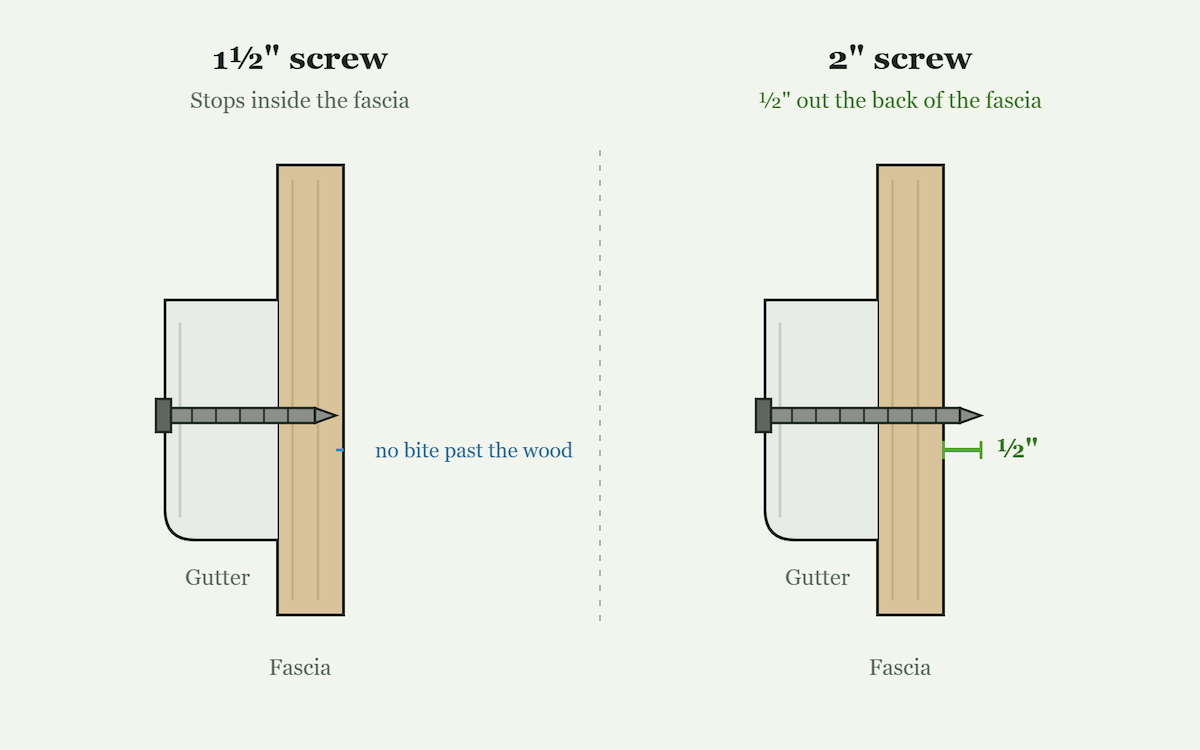
Same eave, same gutter. One fastener apart.
The downspout outlet
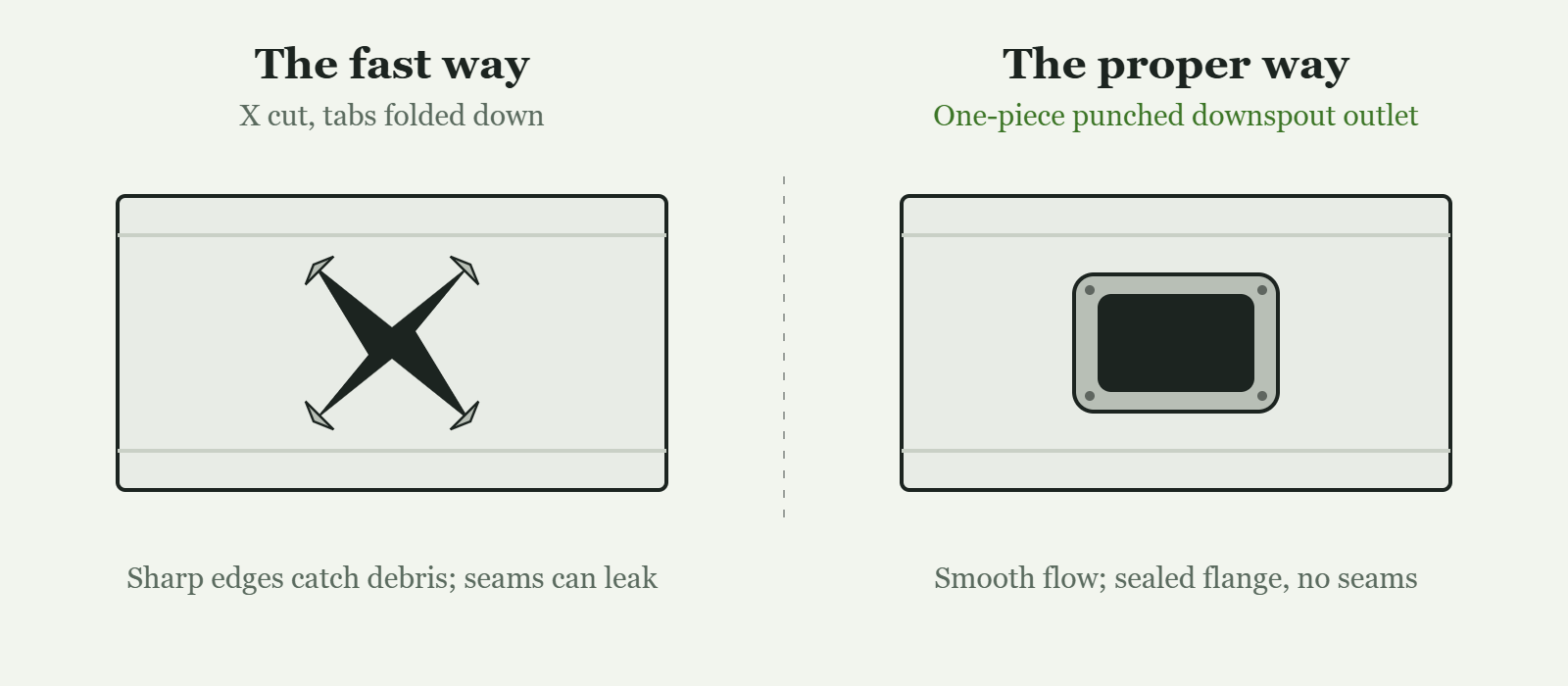
There are two ways to install a downspout to the gutter. The fast way and the proper way. Let me explain. The fast way is to cut an X in the bottom of the gutter so the water can exit, then fold that X down. Seems reasonable, but a couple of things happen. The opening ends up smaller than the downspout. The X leaves holes in the corners that have to be caulked. And leaves get caught on the folded metal, because it is not a smooth finish.
The proper way is to install an actual downspout outlet. More time and a little more work, but worth every minute and dollar. We use a downspout punch-out tool. It cuts an exact hole for the 3×4 downspout and leaves a smooth edge. Then a one-piece downspout outlet sets into it. It sits flat in the bottom of the gutter and extends downward so the downspout screws to it. One piece means the hole stays full size, no caulking in the corners, and more area for debris to flow out. A little extra time and money, but the details matter.
The gutter hanger
The hanger is what carries the gutter, and hangers break. I have seen it. So this is not a part to save money on. We use the Raytec Hangtite hidden hanger, formed aluminum, ribbed, made in the USA. It hooks the front lip of the gutter and runs across the inside where nobody sees it. Then it takes that same 2-inch screw through the back. Hanger, screw and solid wood working as one piece.
Gutter repair in Tulsa: the do’s and don’ts
Over the years we have determined what parts of guttering we do repair and what parts we don’t. Let’s discuss.
The don’ts
Corners and end caps. If the gutters are older and leaky in these areas, we have determined replacement is better than trying to reseal to stop the leak. We don’t work on them. Instead of you giving us a call a year later saying that leak is back, we would rather just replace the gutter.
Gutters that are nailed to the fascia board 99 percent of the time are not repairable. Mainly because to make an adjustment you have to pull the nails out, which in many cases damages the gutter. For us the rule is gutters that are nailed need to be replaced.
The do’s
What we normally do is realignment. Maybe one side is sagging or pulling loose, we re-secure it, put a level on the guttering and get the pitch right. Another one is replacing loose screws, and those come from the shorter screw, usually that 1-1/2 inch size. Gutter cleaning is standard too: scraping out the granules off the roof and the dirt that builds up.
Do you repair gutters or replace gutters? That is a good question, and it depends on the factors we just discussed. We love options and we will give you those options. If you choose a repair, that is fine with us. If replacement is best, your options will be provided.
Seamless gutters: let’s talk options
Seamless guttering is the only way to go. Every section of gutter is made in front of your house, one solid piece.
5-inch seamless guttering: the standard size
The standard size, the most common and the one that fits most Tulsa County homes, is 5-inch guttering. Why? Because the 5-inch has enough capacity to hold and disperse water to the downspouts. The 5-inch also looks the best compared to the bulkier 6-inch version. Plus the 5-inch is reasonably priced.
6-inch seamless guttering: the larger option
If you need to hold a lot of water or move a lot of water, the 6-inch version is the option. I always say you get a week’s worth of rain in an hour here in Tulsa. That is what the 6-inch gutter is for. A little bulky, but honestly you either like it or you don’t, and over time most people get used to the larger size.
The downspout: size, shape and placement
In my early years when I thought about guttering and downspouts, really I only paid attention to the gutter. Maybe it was a mindset issue, or just inexperience at the time. Today it is completely different, because downspouts are the driving factor for how fast the water exits the gutter, where that water goes, and some curb appeal.
The size
OK, I have to admit. I am going to choose the size of the downspout for you. On this entire website I tell you that options are best, the more you know. This is going to buck the trend. The larger downspout in Tulsa, the 3×4 size compared to the smaller 2×3, is the best. Same for the round downspout, the 4-inch over the smaller 3-inch. Why? The larger downspout allows the water to exit the gutter faster, and that is extremely important with Oklahoma downpours and storms. The faster that water exits, the longer your gutters will last.
The shape
Shape and style of guttering is pretty limited. The gutter itself, we hang K-style only, it is the most widely installed profile in the country. For the downspout you have the standard square style, or you have the round. Round if you want a fancier look. We do get asked for it from time to time. Honestly, I could not tell you what makes a house right for it, that one is mostly preference. Maybe not the style for everyone and not for every house. Just so you know your options.
The placement
The first question I would ask is whether water builds up around the house. A soggy area, or a spot by a door where it always stands. The answer to that is usually downspout placement. If a downspout can be moved and the gutter pitched the other direction to stop it, that is the plan.
Installing the gutter is where we control the water. This is where we direct it. It is all about location, away from ponding areas, toward a downward grade away from the house. And toward your neighbor’s. Whoops, kidding about that part.
Better planning of the downspouts is where your house will thank you.
A 3×4 downspout has twice the opening of a 2×3, twelve square inches against six. The 4-inch round has nearly double the 3-inch round. At one square inch per hundred square feet of roof, that puts a 2×3 at 600 square feet and a 3×4 at 1,200.
Sizing rule from the U.S. Department of Energy’s Building America Solution Center
Gutter guards in Tulsa
Gutter guards, in our opinion, have to do a few things. The first is that in a heavy rainfall all the water must enter the gutter without any restriction and without overflow. Also, gutter guards must keep the debris out of the gutter, but they should also be accessible, able to come off so you can double check the gutter for buildup. And the final one: I really don’t think gutter guards should cost a fortune. My opinion.
EZ-Lock gutter guards
The main gutter guard we sell is the EZ-Lock style, a powder-coated steel screen with holes about 9/32 by 3/16 of an inch. It snaps into the front of the gutter, comes off by removing a couple of screws, and runs about $7 a foot.
ProThe pro is water. All of it gets into the gutter with no restriction. Doesn’t matter if it is raining cats and dogs and horses and cows. Haha. And the guard comes off so the gutter can be checked.
ConThe con is debris. Pine needles go right through the holes, and finer debris comes with them.
LeafBlaster Pro micro-mesh
The other one we sell is the LeafBlaster Pro, stainless steel micro-mesh on an aluminum frame. It costs more than the EZ-Lock.
ProThe pro is debris. Nothing gets into the gutter.
ConThe con is water. In a heavy rainfall the water can run over the guard and past the gutter.
Green Country Roofing: the facts about us
Around Tulsa
Green Country Roofing is based at 4734 S 179th E Ave in Tulsa and hangs gutters throughout the metro and northeastern Oklahoma. Tulsa, Sand Springs, Skiatook, Catoosa, Collinsville, Owasso, Bixby, Broken Arrow, Glenpool, Jenks, Sapulpa, Claremore, Inola, Coweta, Wagoner, and throughout Tulsa County.
Seamless guttering FAQ
How much do seamless gutters cost in Tulsa?
About $10–$12 per foot installed for 5-inch and $14–$16 for 6-inch. Most full jobs land between $2,200 and $3,500. The real number comes from measuring your guttering and counting your downspouts.
Should I repair my gutters or replace them?
It depends on what’s wrong. Sagging and loose screws are a repair, we re-secure it, put a level on the guttering and get the pitch right. Leaky corners and end caps, and gutters nailed to the fascia, need replacement. We’ll give you both options and the price of each.
Are 5-inch or 6-inch gutters better for a Tulsa home?
The 5-inch fits most Tulsa homes, paired with the larger 3×4 downspout, it moves the water fine. If you need to hold a lot of water or move a lot of water, the 6-inch version is the option.
Why do my gutters overflow even when they are clean?
The first is the pitch of the guttering is wrong, or a section of guttering is sagging and creating a low spot which causes water to overflow. Another is a small section of guttering, a 3-foot piece or smaller, possibly getting more water than it can handle. That is where enlarging to 6-inch guttering can solve this issue. The last is the downspouts: too small, or not enough of them. Adding a downspout is common. Widening one can get tricky.
Do gutter guards actually work?
Yes, gutter guards absolutely work. The question is more about how much you want to pay. The simplest and most cost-effective is the EZ-Lock brand, and that’s what we prefer for Oklahoma rainstorms. Trust me, you can spend a small fortune on a gutter guard. For me, basic is best.
Do I need drip edge with new gutters?
Drip edge is the metal at the edge of the roof that sends water off the shingles into the gutter instead of behind it. It’s hard to give a straight answer because it depends on the gutter guards. With the EZ-Lock style you should have drip edge installed. Other versions like the helmet style, you may not need it. To be honest, I think every roof should have drip edge installed.
Do I need new gutters when I get a new roof?
No, you don’t have to get new gutters with a new roof. New guttering can be installed at any time. But installing a new roof and new guttering at the same time, I think you get a better roof installation and a better gutter installation, because everything goes in fresh. You don’t have to cut the drip edge around the hidden hangers, for one. And for the guttering, it’s easier to replace a trim board when the roof and the gutters are off. So you get a better gutter installation job as well.
How long do gutters last?
Gutters can last a really long time. Aluminum gutters don’t rust, so as long as you do the yearly maintenance of cleaning the gutter, maybe a quick fix here and there, they can realistically last a lifetime.
Can you repair gutters another company installed?
Yes. If another company installed your guttering, for warranty issues or losing your warranty, I would highly recommend going back to your current guttering company first. If all attempts fail, we can repair other companies’ guttering as long as it isn’t a worst-case scenario.
Sources
The facts on this page come from these records, check them yourself: