
Insurance claims, for Tulsa roofs.
Green Country Roofing is a Tulsa roof company. Being a Tulsa roofing company, you see the good, the bad, and the ugly — the hail and wind damage, falling trees, and crazy straight-line winds. We started in Tulsa in 2018, and started roofing back in 1996. Thirty years of seeing just about everything — and the insurance claims that come after.
You’re not sure the roof’s damaged. You’re not sure you should file an insurance claim. You’re not even sure who to trust. Good — that’s exactly the right place to start. Everything you need is on this page, without even a phone call.
Storm damage problems. Which one is yours?
Whichever one it is — call us, or keep reading.
Shingle granules exiting the downspout
After that one storm — or every time it rains — granules are exiting the downspout.
Shingles in the yard
Are they yours or the neighbor’s? It’s hard to tell from the ground.
Leak appeared on the ceiling
A leak after a storm is an easy sign something happened up there.
A tree came down
First moves: confirm the damage, protect the property. Small limb, we’ve got you. Whole tree through the framing — we’re not the company for that.
Half your roof is missing
Tornado, straight-line winds — whatever it was, you have a major issue on your hands.
Your roof looks faded and rough
It doesn’t have that vibrant look it once had. Maybe you’re wondering if the storms have taken a toll over the years.
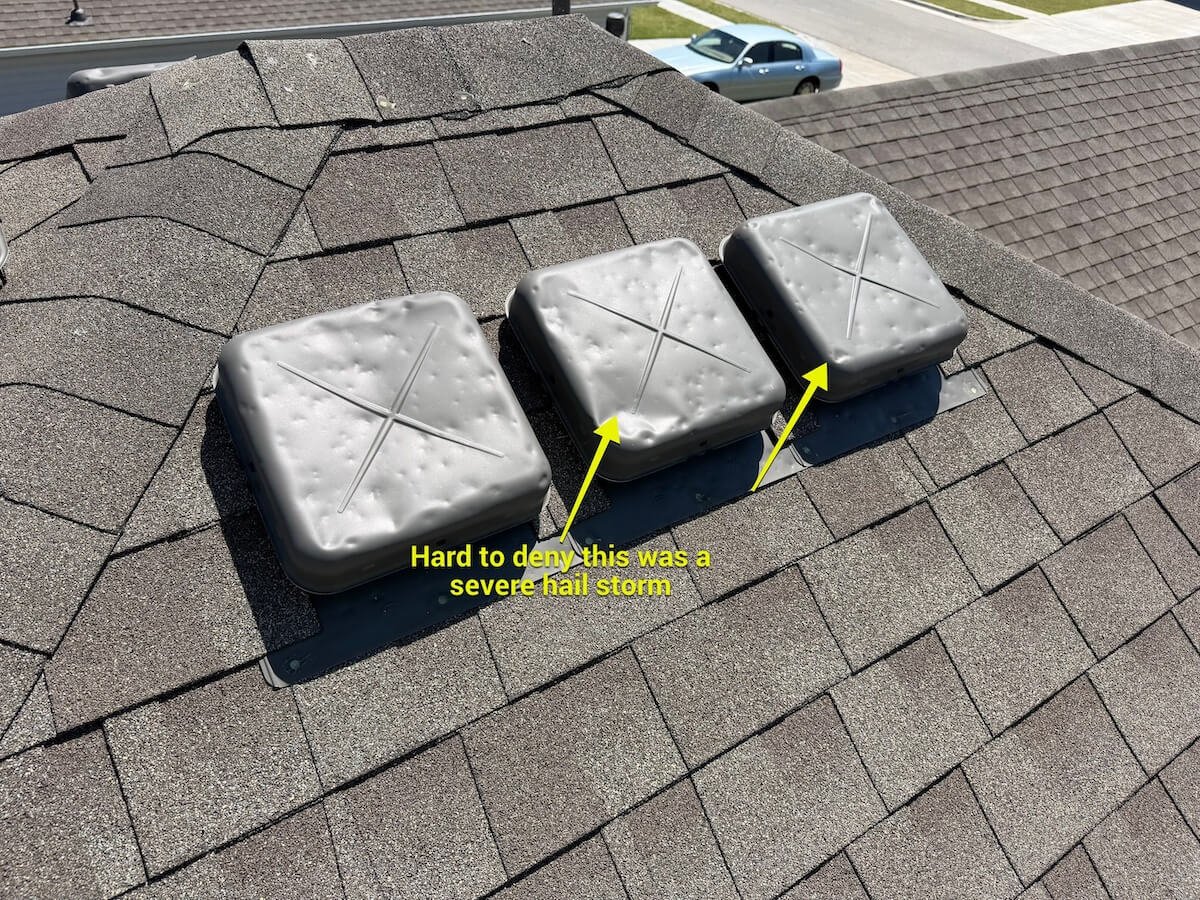
A major hailstorm just hit
Cars are damaged, the roof took it for sure — and probably everything in between.
Insurance denied your roof claim
Maybe you were told you had enough roof damage to warrant replacement. Now you just want the truth.
The insurance check has been delivered
Ready to choose a company and colors — with no drama.
The main points — quick and fast
Eight things worth knowing before anything else.
Stay off the roof
That pitch might look walkable — but after a storm it’s wet and could be compromised. If you’re not a professional, it’s not worth the ER trip.
The mess in your yard tells the story
Document everything before you clean up — photos of everything is key. Don’t be ashamed if it’s hundreds of photos.
Protect your property
Protecting your property after a storm is 100 percent your responsibility — your policy expects it. Before-and-after photos, and keep every receipt.
Confirm the damage
Not every storm deserves a claim. Rushed decisions and insurance claims don’t mix — confirm the damage before you file.
Know what NOT to do
Don’t make rushed or stressed decisions. Don’t be quick to file a claim until you’ve confirmed the damage and your policy. Don’t sign a contractor agreement unless you’ve read the entire document.
Confirm your policy
Confirm three things: wind/hail deductible (1% of home value is common), RCV not ACV on the roof, and building code coverage — Ordinance & Law. Your agent can answer all three in one call.
Know how a claim actually works
When you file a claim, an insurance adjuster comes out to evaluate the damage. He has two jobs. First: is there storm damage or not? If not, the claim is denied. If there is, they write up an estimate for the damage.
Don’t go cheap on an insurance claim
If you have the correct policy in place — including building code coverage — you don’t have to go the cheap route. Soffit vents, extra roof vents, full replacement of step flashing and chimney flashing should all be included. Think lifetime warranties and a full roof brought up to building code — not just cheap shingles and that’s all.
Why Tulsa roofs take a beating
Hail. Wind. Rain. Heat. Five years, four ways.
In Tulsa we don’t talk about IF a storm is going to hit. We talk about when, where, and how bad. Roofs are the same story — around here a roof lasts about 15 to 19 years. We work on that every day with better airflow in the attic and better materials, but the weather sets the terms:
Hail. 2025 was the most active hail year we’ve seen near Tulsa: 34 hail reports within 10 miles in a single year, per NOAA’s Storm Prediction Center. And the NWS says any given address in the metro averages hail 2 to 3 times a year.
Wind. The 2023 Father’s Day derecho hit Tulsa with winds around 100 mph — the first 100-mph wind warning in the Tulsa office’s history. More than 200,000 lost power. Since then: a 72 mph gust in 2025, an 82 mph gust in 2026.
Rain. April 2025 was the wettest April on Tulsa’s record books — almost 11 inches, with 4.14 in a single day, breaking a 1974 record. That much water washing over aging shingles takes granules with it, every time.
Heat. Summer 2022 hit 100 degrees on 27 different days — an average year gets 11. Hot summer after hot summer bakes the flex out of every shingle, all season, every season.
And that’s just the recent history — the biggest hail on the books near Tulsa since 2004 measured 4.25 inches. Hold a softball. NOAA’s severe storms lab says hail that size can fall at more than 100 miles an hour. Those NOAA storm records matter later, too — when a claim gets reviewed, they help tie your roof damage to the date the storm actually hit.
What to do when a storm hits your roof
Most Tulsa homeowners have never done this before. Just what actually matters, in order.
Secure your family first
Make sure everyone is safe and in a secure location before you think about the roof. The house can wait. Property can be fixed. Family comes first.
Confirm the weather report
Severe weather means an unstable atmosphere — one storm through doesn’t mean it’s done. Check the news or radar and confirm nothing else is coming before anyone heads outside.
Stay off the roof
A rain-soaked roof is slick — and depending on the storm, unstable or dangerous to walk on. It’s best to have a professional take a look instead of you taking the chance.
Walk the ground
Do a lap around the house. Shingles in the yard — yours or the neighbor’s. Dents in gutters. Damaged fascia. Granules pooled at the downspouts.
Photograph everything BEFORE you clean up
Photograph everything exactly where it fell — the grill on its side, shingles in the yard, hail next to a tape measure. Evidence cleaned up is evidence gone.
Secure your property
Securing your property is your sole responsibility — your policy expects it. Temporary fixes now keep small damage from becoming further damage later. Call your agent for guidance, a tree company, or a roofer, and keep receipts for everything.
Confirm the damage
Don’t be quick to file an insurance claim. Once the property is secured, take time to assess the roof damage. Full replacement or repairable? Need help determining that — call us.
Check your policy
The insurance policy tells you what’s covered and how much is your responsibility — Replacement Cost Value (RCV) or Actual Cash Value (ACV), the wind and hail deductible, building code coverage. The policy matters. The fine print matters more.
File the claim
Filing should only happen once you’ve confirmed every step above. Nothing is more frustrating than an insurance claim that pays less than you thought — or gets denied for lack of damage.
What NOT to do after a storm
Nine avoidable mistakes — if you see them coming.
Don’t stress or freak out
Don’t panic, and don’t do anything crazy. It’s beyond easy to make a spur-of-the-moment decision that sounds good right now — and find out later it was the wrong one.
Instead: slow down. This is why we created this page.
Don’t do things you’re not used to
Removing that large tree in the yard, checking that wet, slick roof — maybe not a great idea if you’re not experienced. Stay safe, be smart, and call a professional when needed.
Instead: if it’s not your normal, it’s not your job today.
No proof, no payout
The wind throws your patio furniture across the yard and breaks it. You clean it all up — no photos. The insurance adjuster comes out: no photos, no proof, maybe no payout.
Instead: document it where it landed. Then clean up.
Don’t rush the claim
Nobody likes surprises, and a rushed insurance claim is full of them — damage below the deductible, coverage that isn’t what you assumed, fine print you never read. Know first.
Instead: damage confirmed, policy checked — then decide. In that order.
Don’t sign before you read
Signing an insurance contingency contract you haven’t read or don’t understand can cost you 20 percent of your claim if you cancel. If the pressure gets turned up — that’s not a good sign.
Instead: take your time. Read every line before you sign.
Don’t fall for the free roof
A waived deductible doesn’t disappear — it comes out of the roof. A company eating $3,000 builds you a $3,000-cheaper roof: low-wage crews, generic materials, corners cut where you can’t see.
Instead: budget for the deductible. Every dollar of it ends up on your roof.
Don’t judge the roof from the ground
The true condition of a roof is only found on the roof. Loose or creased shingles, granule loss from hail — often none of it is visible from the ground.
Instead: storm hit your area? Get the walkthrough even if it “looks okay.”
Don’t repair, just secure
Securing is temporary — tarps, covers, keeping water out — and your policy expects it. Repairing is permanent, and done before the insurance adjuster’s inspection, it can undo the insurance claim itself.
Instead: secure now, repair after the claim settles. The order is the whole thing.
Don’t wait months to act
Sure, you have 12 to 24 months to file. But insurance claims tend to go smoother right after a storm — and fresh damage reads as storm damage. Old damage just looks grey and worn.
Instead: get it looked at ASAP. Fresh evidence is the strongest evidence.
Knowing your insurance policy
Five factors that matter for your roof and pocketbook — then the math on a real scenario.
A disclaimer before we start: we’re not insurance policy experts, and we’re not public adjusters. We’re roofers — who’ve seen firsthand how variations in policies have affected our customers. Clarifying anything about your specific policy should be done strictly with your insurance agent.
RCV or ACV
An RCV policy pays the full cost to replace your roof at today’s prices, with the depreciation recoverable. An ACV policy pays by the roof’s age, and that depreciation is not recoverable. It never gets released to you.
Wind/hail deductible
You could have one deductible for normal claims — a burst pipe — and a separate, higher one for wind and hail. It’s often a percentage of the home’s value, not a flat number: 1% on a $250,000 home is $2,500 — your out-of-pocket expense on a hail/wind claim.
Building code coverage
On your policy this may be listed as Ordinance & Law. A replacement roof has to meet today’s code — extra vents, drip edge, updated flashing — and this coverage is what pays for those required items, even on an approved claim.
Metal marring & cosmetic damage exclusions
Either one means simple dents — in the gutters, on the vents — won’t get paid for. The same goes for the asphalt shingles: granule loss alone, from hail or other weather, gets called cosmetic and isn’t covered.
Roof matching endorsement
Carriers sell this under different names — matching coverage, line of sight coverage — but the job is the same: when the current shingles can’t be matched in color, dimension, or style, it increases the likelihood of a full replacement. And shingle lines get discontinued all the time.
The math on a real scenario
The storm totals the roof. Full replacement, including $2,000 of code-required items: $20,000. Slide your home’s insured value and watch the two policies part ways:
| Policy A — 1%, code covered | Policy B — 2%, no code | |
|---|---|---|
| Wind/hail deductible | 1% — $2,500 | 2% — $5,000 |
| Building code coverage | Covered | $2,000 |
| Insurance pays | $17,500 | $13,000 |
| Your out-of-pocket total | $2,500 | $7,000 |
Why roof claims go sideways
Four hands on every claim — the adjuster, the roofer, the agent, and you.
For every roof insurance claim that goes sideways, there’s one that goes really well. This isn’t about the extremes — it’s about the middle ground: the claims where one thing done differently — a better policy in place, one step not skipped — and the whole process would have gone smoother, or the trouble never would’ve started at all.
The adjuster
Between adjusters and insurance companies, there doesn’t seem to be a universal consensus. Every adjuster is different, and they answer to supervisors who are different too — variation on top of variation. One adjuster can have 30 years of on-the-job training; another is twenty-five and still learning. Since we’re never sure which adjuster will show up, we’re never sure which direction the claim will initially go. Straight or sideways.
The roofer
Some roofers file an insurance claim on every roof they touch, damage or not. That’s a claim starting sideways on day one — an adjuster walks a roof with no real damage, and the whole process begins as an argument instead of a walkthrough. Are we, the roofers, sometimes part of the problem? Honest answer: yes.
The agent
Agents are different too. Some know exactly how building code coverage works at claim time; plenty genuinely aren’t familiar with it. Some policies get sold to be used; some get sold on price — ACV, high deductible — and those were sideways at signing, years before the storm. The gap is the distance between selling on the cheap and using.
The homeowner
Sorry — you’re not completely off the hook either. It seems not many read the policy, let alone the fine print — I’m guilty of the same in other corners of my life. Most homeowners find out what they bought only when they have to use it. And it’s devastating to find out the wrong policy is in place when you need it most.
The perfect claim experience. Possible? Almost. Claims can always go sideways — for any reason. But with the right policy in place, a well-trained roofer who isn’t motivated by the sale, a highly trained adjuster, and a homeowner educated on their own policy — the likelihood of the claim going sideways is minimized. All four hands are part of the solution.
What we’ve seen storm claims pay for
What your policy covers is between you and your insurance agent.
Based on our experience — this is what insurance companies have paid for on real insurance claims we’ve worked:
The roof — Including detached garages and sheds. Same storm, different roofs, different damage — each one gets its own look.
Gutters and downspouts — Dented by hail or pulled loose by wind — gutters have been included.
Siding — Cracked, chipped, or dented by the storm — siding has been covered.
Windows and screens — Broken glass and hail-holed screens have both been included.
Garage doors — Hail dents the door, the door’s been covered. A tree takes it out, the framing came with it.
Fencing — Wind-downed sections and hail-beaten rails have both been included.
Outdoor light fixtures — Dented caps and broken globes have been paid.
Grills — Flipped or dented by the storm, grills have been paid.
Interior damage from storm leaks — Ceiling stains, wet paint, damaged flooring — the inside damage has gone on the claim too.
For anything you have that’s not on this list — confirm whether it’s covered or not.
The insurance claim process, step by step
Ten steps, from first look to final check.
A true story first. Years ago a young lady ran a red light and T-boned my car. Injuries and all. And I remember sitting in that hospital so worried about filing a claim that I almost didn’t want to. It felt like such a big deal. Then I got released, started driving again — and suddenly I saw accidents everywhere. And I thought: shoot, this happens all the time. If you’re feeling that same hesitation, I’ve been there. Here’s how the process actually works — because the unknown is usually the scariest part.
Confirm the damage
Sometimes you already know a claim has to be filed. If you’re unsure, a walkthrough or roof walkthrough answers it. Either way, nothing gets filed until the damage is confirmed and the policy is checked — the two steps most claims skip.
Confirm the policy
The five factors covered above — RCV or ACV, the deductible, code coverage, exclusions, matching. One call to your agent confirms all five before anything gets filed.
File the claim
Most people call their agent or the 1-800 number — but policies carry other filing methods too, and that’s a conversation with your agent. Whichever door, this step is where the claim number comes back.
The adjuster inspection
The insurance adjuster has two jobs: determine whether there’s storm damage or not — and if there is, write an estimate based on what was damaged. The visit comes in two kinds: photo-only, reviewed and decided by an in-house adjuster, or on-site with authority to approve on the spot. Either way — you, or your contractor, should be at that appointment.
The decision and the scope of loss
The claim comes back approved, partially approved, or denied. Anything approved comes with a scope of loss — the insurance company’s list of what’s damaged and what they’re paying for each item. Compare it against your own documentation — the photos, the notes, the contractor’s estimate. The scope should match what’s actually on the roof.
Repair or replacement
Some storm damage requires replacement. But what if it isn’t that bad — a couple shingles, one section? In those cases, non-repairable shingles, discontinued shingles, or a match that can’t be made are what turns a repair into a replacement.
Understanding the money
A Replacement Cost Value (RCV) claim typically pays in two checks: the first up front, the recoverable depreciation after the work is completed and documented. The deductible is the homeowner’s — approved for $15,000 with a $3,000 deductible means a $12,000 check.
The supplemental process
If the insurance estimate came up short — something the adjuster missed, or damage found once the old shingles come off — that’s what a supplement is for: document the damage, submit it, and the claim gets adjusted.
Work completion
The claims process can take a month of paperwork — and the roof goes on in a day or two. Photos of the finished roof get taken — the insurance company needs them for the depreciation.
Final paperwork and depreciation
Completion documents — final invoice and photos — go to the insurance company, and the recoverable depreciation gets released. The claim closes. The roof is done.
Pick a contractor without getting burned
Our registration: OK #80005519 — check us first.
I know what you’re thinking — hiring a contractor is easy, because ten of them will be at your door before the end of the day. But not hiring one of those ten might be the hardest thing you do. And the best thing.
Build a list
Instead of hiring the first guy or the fifth guy who shows up, build a list. Find 5 to 10 contractors — a few from the internet, a few from the door — and start tracking their behavior. Did they return your call the same day? Did they show up when they said they would? You cross names off until you’re down to 2 or 3. Then you make your decision.
The deductible is yours — by law
In Oklahoma it’s illegal for a contractor to pay or waive your deductible — House Bill 1940. Then again, nobody ever speeds either. Haha. A waived deductible isn’t a discount — it’s a confession. The company just gave up $3,000 and still has to build your roof. Is that a scam or a bad business model?
What the contract can cost
Nothing matters if it’s not in writing. An insurance contingency contract locks you in. Signed at your home, federal law gives 3 business days to cancel — and a written claim denial gives 72 hours more under Oklahoma law. After that, canceling typically costs 20 percent. One more detail: the insurance company doesn’t have to honor a contractor’s estimate. The scope of loss is the number.
Check the registration
Oklahoma doesn’t license roofers — it registers them. Before anything gets signed, check that the roofer is registered and in good standing: verifyroofing.cib.ok.gov. If they’re not on it, move on. Ours is #80005519 — check us first.
Quick side journey. I was already working with a customer when a hailstorm hit the Sand Springs area. Days after the storm, I was entering the neighborhood and, I’m serious, there were tons of roofing signs at the entrance of the sub. I left to get supplies — and when I came back, every yard sign had been pulled except one. That one company pulled all the other signs and planted their own. I couldn’t believe it.
Pushy salespeople are a sign it’s all about the numbers. A good contractor explains your options and lets you decide.
Roof insurance claim questions, answered straight
Tap a question to open it.
Does insurance cover my roof damage?
Storm damage — wind, hail, falling limbs — is what a homeowner’s policy exists for. Normal aging and wear is what it doesn’t cover. The whole question comes down to what caused the damage, and that’s what a walkthrough determines.
How long do I have to file after a storm?
In Oklahoma, generally 12 months — and up to 24 in certain cases where damage couldn’t be seen without a walkthrough. But the exact window lives in your policy. Claims filed while the damage is fresh tend to go smoother.
Will filing raise my premiums?
Here’s what we’ve seen: after a big storm, rates tend to rise across the whole area — filers and non-filers alike. The storm hit the map, and the map is what the insurance companies price.
Should I even file a claim?
Not every storm deserves one. Damage below your deductible, or no real damage at all — that claim helps nobody. Confirmed damage that clears the deductible is a different story. Confirming comes first; filing comes second.
RCV vs ACV — what’s the difference?
RCV pays what your roof costs to replace today. ACV pays what your aged roof was worth — and the difference stays out of your pocket for good. It’s the single biggest factor in what your claim pays. The full story is in our RCV vs. ACV blog.
Do I have to pay my deductible?
Yes — it’s your share by contract, and in Oklahoma it’s illegal for a contractor to pay it for you. The money a company gives up covering your deductible comes back out of your roof somewhere.
How long does a claim take?
The paperwork side commonly runs a few weeks to a month or more — every claim is different. The roof itself goes on in a day or two. The waiting is almost all paperwork, not construction.
What if my claim is denied?
A denial isn’t always the final word. A second walkthrough can be requested, and adjusters have reversed on a second look. And sometimes the denial is correct — an honest roofer tells you which one you’ve got.
What if the payout seems too low?
Scopes miss things — it happens on real claims all the time. Missed damage that’s documented gets submitted back to the insurance company as a supplement, and approved supplements get added to the claim. The scope isn’t always the final number.
How do people get a roof replaced for free?
They don’t — not legally in Oklahoma. House Bill 1940 makes it illegal for a contractor to pay or waive your deductible, and a “free roof” pitch just means the money comes back out of the roof somewhere — cheaper materials, cheaper crews, corners cut where you can’t see. Budget for the deductible. Every dollar of it ends up on your roof.
Is my roof too old to file a claim?
No roof is too old. Storm damage is storm damage at any age — and an older roof is actually more likely to end up with a full replacement, since older shingles are harder to repair and harder to match.