
Hail damage, on Tulsa roofs.
Here at Green Country Roofing we often hear it from Tulsa homeowners, customers and friends alike: “I don’t know if my roof has hail damage — I can’t see anything from the ground.” And then the standard saying: “Well, it looks good from the ground.”
The hail we live with in Tulsa
Golf balls on Collinsville
Golf-ball-sized hail fell on Collinsville for a solid ten minutes. Hen-egg stones — two inches — landed just east of Owasso, with reports up to two and a half inches. Storm spotters measured 3¼-inch hail in Bartlesville the same evening.
The storm Tulsa roofers still talk about
NewsOn6 reported it that spring: an estimated 30,000 damaged roofs in south Tulsa alone, insurance companies renting storefront space just to handle the claims, and roofers taking months to catch up. South Tulsa, Bixby, and Broken Arrow took the worst of it.
hail events a year, any spot in town — per the National Weather Service in Tulsa. The odds peak in April and May.
mph on impact — NOAA’s severe-storms lab: big hail, 2 to 4 inches, lands at 44 to 72 mph. That’s why it breaks anything it strikes.
months with hail on record — over 50 years of NWS record-keeping, no month on the Tulsa calendar is without a hail report. Even December and January. There is no off season.
The short version
Want the full story? It’s all below.
Check these first after a hailstorm
Not getting on the roof? No problem. Step one: look at your car. Next, look for granules exiting the downspout, rips in window screens, cracks around the window frames, dents in the garage door and gutters, chips in the siding.
The long version — Part 03 ↓What to do after hailstorm damage
Stay off the roof — nothing up there is worth breaking a bone. Take pictures while the damage is fresh. Severely damaged? Secure your property. Confirm the damage; confirm your policy. If there’s a green light on both, filing a claim is your decision.
The long version — Part 04 ↓How a shingle is made
A shingle has three layers: a fiberglass mat on the bottom — the skeleton, asphalt coating over it — the waterproofing, and granules, small rocks placed in that asphalt, with two jobs: protect the coating and give the shingle its color.
The long version — Part 05 ↓What hail damage does to a shingle
Hail can break clean through a shingle, fracture the fiberglass mat underneath, or knock granules off the asphalt they protect. Sometimes it only loosens them — and the wind and rain channel them into the gutters and down the downspouts.
The long version — Part 06 ↓Hail damage isn’t always sudden
Imagine the difference between 3-inch hail hitting your roof once, and 1-inch hail hitting it every year for 15 years. One is instant damage; the other takes time — minor roof damage adding up year after year. Both can end in a new roof — one just isn’t apparent yet.
The long version — Part 08 ↓How a hail damage roof gets approved
Every roof is split between slopes — the sides of the roof, each facing its own direction. Each slope gets inspected. We’ve noticed 7–10 hail hits per 10’x10′ has been the standard.
The long version — Part 09 ↓Impact-resistant is not hail-proof
There’s a big push from insurance companies — and from us — toward roofs that hold up against Oklahoma weather. But even Class 3 and 4 shingles rated for hail damage won’t always hold in the biggest storms. They’re good, but not fully resistant.
The long version — Part 11 ↓Class 4 upgrade must include steel flashing
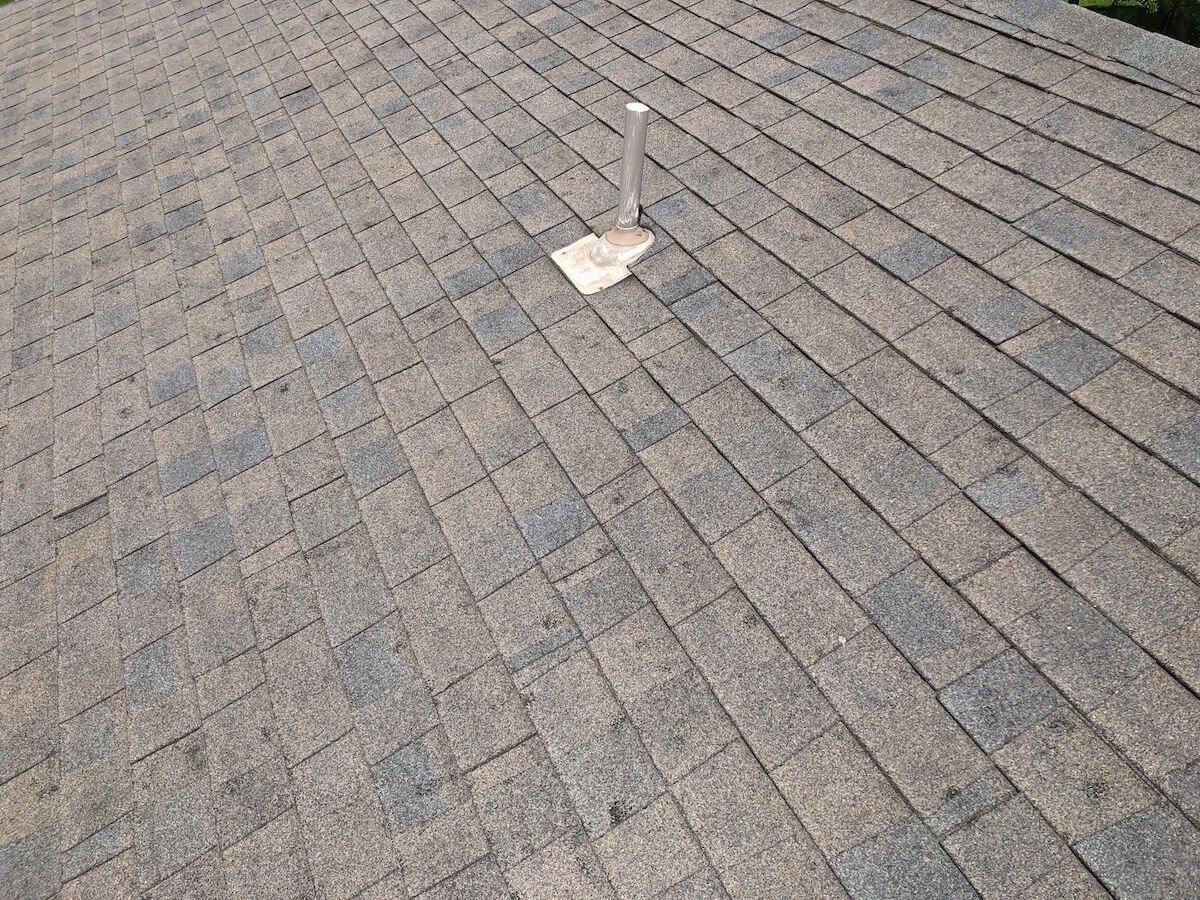
Vents made from aluminum prove a hailstorm — it dents easy. That makes it a weak roof part. In the state that leads the nation in small-hail days, a Class 4 roof deserves steel pipe flashings and steel vents, all-new.
The long version — Part 12 ↓How to check your roof for hail damage — without a ladder
To be honest, there’s really no foolproof plan to know if your roof has hail damage — or if you should file an insurance claim. The key is what’s called collateral damage: supporting evidence for a roof insurance claim. If a hailstorm hit your roof, in most cases — but not all — it damaged items around your house too: guttering, flashing, siding, and more. Those can be inspected from the ground — and with a good camera or phone, hail damage to roof vents and pipe jacks might be seen right from a picture.
The flashlight tip: metals — the car, garage door, gutters — get the flashlight and shine it at different angles. Depending on sun direction, a dent might not reflect and consequently get missed. Here’s the walk-around, in order:
1The car
We don’t have to act like rocket scientists here — start with easy things. Did the car sustain damage? Hood, roof, trunk lid. Was the hail directional? Start on that side first.
2Granules exiting downspouts
Hail’s first move is knocking granules loose — small rocks that pile up or scatter. Did they exit the downspouts? Driveway, flower beds, back porch? Is there a little or a lot?
3Roof vents and flashing
Zoom as far as the photo stays sharp. Dents in metal are the target — roof vents, and flashing around pipes that stick through the roof. Large hail needs no photos.
4Gutters and downspouts
The angle matters on guttering — look a long way down the side, and use the flashlight. Hail dents gutters outward; downspouts take inward dents.
5Window screens and framing
You’re looking for tears in the window screens and chips around the framing. Plus, large hail can break window seals — look for new moisture between the panes.
6The AC unit
There’s a term called splatter. When hail hits metal, it knocks off the old dirt and grime — the buildup is called oxidation — and leaves a clean mark. Look for splatter marks and damaged fins around the unit.
7The color of the roof
The color comes from the granules. If your roof is faded — not as vibrant as it once was — it may have sustained several hailstorms over a period of time.
8The final tip
Take your time. Walk around your property, look at everything, and photograph anything you see or are concerned about.
“This one comes from my lovely wife. She says if tennis-ball size hail has fallen from the sky, you have damage to your roof. Haha! She’s not wrong.”
What to do if you suspect hail damage
1 Stay off the roof
Most Tulsa roofs are steep and tricky to navigate — nothing up there is worth risking injury. Depending on the steepness, close-up photos are the better option. Can’t see much? Look for collateral damage around the house — it can give as good an idea of the damage as the roof itself.
2 Photograph what you see
When damage is fresh — that’s the time to take photos. Tulsa weather can be brutal; it fades damage or makes it look old fast. Take an hour, view every inch: close-up, medium, and far-away shots. Look for dents, splatter, chips, and cracks. Make a list of everything that’s damaged.
3 Confirm the damage
Not all hail damage is created equal, and it doesn’t show up the same way from home to home. Confirming the damage on your roof is real and legit matters — it keeps you out of the situation where a claim gets denied for lack of damage. Spend a little extra time and confirm.
4 Confirm your policy
Not all insurance policies are created equal — and neither are the payouts. Every insurance company writes its own fine print, so call your agent and confirm your policy. From the claims we’ve worked: Replacement Cost Value, a low deductible, building code coverage, and no marring exclusion treat the pocketbook best.
5 The claim is your decision
Filing a claim should always be your decision. If you’re ever pressured to file a claim — storm chasers are famous for it — you might want to take a step back. Let the facts guide you: Can you see the hail damage and understand it? Is the correct policy in place? Is it the right financial move?
For more information about the claims process, visit our Insurance Claims page. Now we switch gears — from what to do, to the process: how hail damage affects shingles.
What a roof shingle actually is
To understand hail damage to shingles, you have to have an idea of how a shingle is made. That understanding tells you — or helps you judge — whether you have major damage or light damage. And if the roof doesn’t get replaced, it’s the process by which the roof starts to fail over time. Three layers make a shingle, and each one has a job.
The fiberglass mat
That’s the frame of the shingle — it holds everything together and gives the shingle its shape and its strength.
The asphalt coating
That’s the water seal — the layer that actually keeps rain out of your house.
The protective granules
Pressed into the asphalt on top. They aren’t decoration. They are sunscreen. Asphalt’s one weakness is direct sun — it dries out and cracks. So the granules take the sun and the weather, and the asphalt underneath stays soft, sealed, and working.
What happens when hail hits a shingle
When it comes to hail damage on a shingle roof, there’s going to be variation. Part of it is the storm’s path — did you take a direct hit, or catch the outer band? Part of it is the roof itself — newer, or old and worn out. Here are the main ways hail damage hits and affects a shingle.
Granules knocked off or loosened
This is the most common hail damage in Tulsa. When small or medium hail hits the shingle, the first thing the hail is going to do is either knock the granules off or loosen them. If the roof is not replaced, year after year more granules will continue to blow off or get washed away by the rain.
The fiberglass mat gets fractured
As the hailstone size increases, the damage moves through the granules and asphalt and into the fiberglass mat. A fractured mat affects the internal structure of the shingle, leaving it prone to leaks and failure. This is called bruising, and it’s severe damage. Damage at this level puts a shingle into must-be-replaced territory — and it’s risky to leave it.
The shingle gets punctured
Many storms a year bring hail so large — or moving so hard — that the hailstone completely punctures or breaks through the entire shingle. This kind of damage rides with the biggest storms, the ones that do devastating damage not just to the roof but to other parts of the home, and to cars left outside.
To be clear: all three of these are considered damage. Yes, some more than others — but the smaller storms can create just as much damage over time. Don’t look past the smaller storm so easily.

What size hail damages a roof?
Size still tells the biggest part of the story. According to the National Weather Service and Haag’s published research on asphalt shingles, here’s where functional damage begins — by the size of the stone. This is their research — their testing and their findings. We didn’t want this part to be about us or our opinion. It’s third-party research on purpose. Drag the stone up — or press a rung.
| Stone size | The everyday name | Where functional damage begins |
|---|---|---|
| 1 inch | Quarter | The National Weather Service’s severe line. In Haag’s testing, one-inch stones damaged aged 3-tab shingles half of the time. |
| 1¼ inch | Half dollar | The size it took to damage aged glass-fiber mat shingles in testing. |
| 1½ inch | Ping-pong ball | The size that damaged thicker, aged laminated — architectural — shingles. |
| 1¾–2 inch | Golf ball | Now even Class 3 and Class 4 impact-rated shingles can take damage. |
| 2¾ inch + | Baseball | Punctures. Cracked decking. |
Wind changes everything
Research from the Insurance Institute for Business & Home Safety found that hail driven sideways by high winds hits with far more force than the same stone falling straight down. A ¾-inch stone in a 60 mph wind can out-hit a 1-inch stone in calm air. In the windy city of Tulsa, that matters.
How small hailstorms affect shingle roofs over time
Asphalt shingle roofs are honestly nothing special. They’re not 24-gauge steel, and they’re not rock-hard like a tile roof. They’re an affordable roofing option, and they have their flaws. In a normal weather climate, yes — they can last 20 or 30 years. In Oklahoma, it’s more like 15 to 19.
Yes, this is the hail damage page. But before you even think about hail damage, take into account the high-wind events, the heavy rains, the sleet — and the kitchen sink. Now add the numbers we’ve talked about: Oklahoma leads the nation with some 28 small-hail days a year, per the Insurance Institute for Business & Home Safety — and the National Weather Service says any spot in Tulsa can take its own two or three hail reports a year. What happens over a 10- or 15-year period? Here’s what happens, year after year, as the small hailstorms mix in with the occasional medium-sized stone — granules are loosened with each one. Just a little bit, every year:
You don’t notice anything.
A few granules start showing in the gutters or downspouts.
Years of small hailstones take effect here. Check the gutters.
The faded look we talked about shows up. Call your local roofer.
And this is the key. The small hailstorms come in and loosen the granules on the shingle. Then at some point a larger hailstorm hits and creates replacement-type damage. The issue: if the roof isn’t replaced directly after that hailstorm, that’s when the extreme granule loss starts. And every year it goes unreplaced, the hail damage and the standard granule loss blend a little further together.
Insurance claims: when a roof needs to be replaced
There are two key elements when it comes to replacing a hail-damaged roof on a claim. The first is the test square — run by slope, or by directional roof section. The second is the collateral damage: the additional items that support hail damage to the roof.
The insurance test square
The insurance test square is simply a 10’x10′ area, marked out in a box, that’s considered the area to check for hail damage. This happens on every slope of the roof — each slope or roof section facing north, south, east, and west gets tested. That means 2–4 sections of the roof get tested on an insurance adjuster appointment. The test square gets inspected for hail hits — what adjusters call hail strikes. It’s the method Haag Engineering developed back in the 1960s, and it’s still the standard. Around 7–10 hail hits per square is the working number, and the count needed to approve a roof varies per insurance company.
The collateral damage
The other part of the claim is the collateral damage — the supporting evidence. If hail hit the roof, it also hit the roof vents, pipe flashings, and the furnace and hot water caps. That’s the first place an insurance adjuster looks — roof vents dent easy, and they’re the easiest thing to see. Good damage on the vents tells him hail hit the roof. The question left is how bad.
Final roof replacement
If all the test squares on each slope show the 7–10 hail hits, and the collateral damage shows consistent hail damage, the roof will be a candidate to be replaced. How much of that lands on you?
Why you need to know the process
The claims process seems to be new to most homeowners — and honestly, that’s a good sign. If you’re an expert in the claims process, that could be a problem. The more you know and understand, the less confusing the process might be… maybe a little less stressful, and a little smoother. The whole thing, step by step — filing to final check — is on our Insurance Claims page.
The damage insurance companies don’t pay for
Honesty time. Not every mark on a shingle is hail damage — and a roof being old or needing replaced isn’t hail damage either. Hail damage is what a homeowners policy exists for. Normal wear and tear is not covered.
Cracks in the shingles
Shingles crack with age. The asphalt dries out, the shingle gets brittle, and cracking follows — usually in lines, heaviest on the sunny slopes.
Blistering
Blistering comes from inside the shingle — heat from a poorly ventilated attic pops the surface from the inside out, and manufacturing defects can do it too.
Granule loss without the hail
Granule loss is a natural process — Oklahoma heat exacerbates it — and granule loss alone isn’t covered. Hail knocking granules off is. Watch for a “shingle marring” exclusion in your policy.
Wear and tear
Wear and tear is the roof simply getting older — thinning shingles, curled edges, granule loss that’s even instead of random and heaviest on the sun-facing slopes.
The pattern is telling. Hail is random and directional — it concentrates on the slopes that faced the storm and it hits the bent shingles hardest: ridges, edges, and valleys. On the other hand, wear is even and predictable. A trained eye reads the difference in minutes.
Are impact-resistant shingles worth it in Tulsa?
Whether we’re in Tulsa, Jenks, or Owasso, the same conversation comes up: are impact-resistant shingles worth it? To start, the rating is earned by dropping a steel ball from 20 feet — twice, in the same spot. Class 3 takes a 1¾-inch ball, Class 4 the bigger 2-inch. No breaking, no cracking — the shingle earns its hail rating.
In our opinion, a Class 3 shingle is the standard install. We rarely install a non-hail-rated shingle unless budget is the only factor. So what we’re really talking about is the upgrade from a Class 3 shingle to a Class 4 — and whether it’s worth the extra cost. For a Tulsa homeowner, that upgrade is based on three factors: 1) the discount your homeowner’s policy gives, 2) how important it is to possibly not have to file another claim if a small to marginal hailstorm hits your roof, and 3) whether you’re planning to move soon.
The Class 4 upgrade runs $500 to $2,500, based on the size of your roof. Think of it like an investment: how long until the savings on your yearly premiums pay you back? Selling your home soon? You might not get your money back. Staying a while? The yearly savings add up, combined with the claim you might not have to file the next time a hailstorm blows in. Curious what a claim would cost you out of pocket? The smart move is always to stay within budget. Don’t stretch yourself to upgrade to Class 4 shingles. Class 3 shingles are great shingles too, and they’ll last a long time.
Hail-resistant is not hail-proof
Shingles are shingles. So even with a Class 4 rating — tested for 2-inch hail — that doesn’t mean the shingle will hold up against anything Tulsa storms throw at it. Owasso, Collinsville, and Wagoner all had their Class 4 rated shingles tested by hail on May 8, 2026 — large hail damaged just about everything it hit, including the Class 4 rated shingles. Even though these shingles didn’t last, this storm was that one-in-10-or-20-years type of storm. Most storms are not this severe.
Two things decide whether that impact-resistant roof lasts
Those two main factors are ventilation and the replacement of flashings. First, you must address any type of ventilation issue — anything that’s not allowing fresh, cool air to enter the attic. The second is to replace all of the flashings with new — and a steel version if available.
Ventilation — the slow cooker
When shingles are new and freshly installed, they are very pliable and tough — meaning they are flexible and able to deflect hail damage. But what happens over time is more hot air gets trapped in the attic. That hot air becomes like an oven that slowly dries the asphalt part of the shingle — like a slow cooker. It does take some time, but 5 years in, those shingles have lost some of that pliability and toughness. And every year after, it gets a little worse — and before you know it, the Oklahoma weather starts to take its toll on that roof. The longer the shingle keeps that pliability and toughness, the better. The 1/300 rule in the building codes makes this a problem you can solve.
Flashings — the bad, the ugly, the rule
The bad and the ugly: replacing all of the flashing is crucial. If you are upgrading the shingle, you don’t want to re-use the old flashing. We have often seen roofs with Class 4 rated shingles — and the original furnace and hot water tank flashings still installed. No one wants good shingles leaking around old rusty flashing.
The general rule: tougher shingle, tougher flashing. Think steel pipe flashings, the lifetime pipe jack, and steel roof vents. Anything aluminum gets removed and replaced with steel. That way the new flashing is strong enough to hold up with the new impact-resistant roof.
Hail damage FAQ
What does hail damage look like on a roof?
The soft metals get noticed first — roof vents, pipe flashings, and aluminum caps all get dented. On the shingles, hail leaves impact marks that look like bruises. They’re usually circular, but not always. And here’s a tell: real hail damage shows up across the whole slope. If one small section has marks and the rest of the roof is clean, more than likely it’s not hail.
My roof looks fine from the ground. Should I still get it inspected?
Yes — still get it inspected. Hail damage wears down an asphalt shingle pretty quickly, and if it never gets looked at, years down the road that damage can look extremely old and worn. Your claim window can pass you by too, and the storm date gets harder to pin down. Think about it this way: A walkthrough that finds no damage costs you nothing. Skipping one can cost you a lot.
How big does hail have to be to damage my roof?
Size is only part of it. A year-old roof and a 15-year-old roof don’t take the same hailstone the same way, and a hail-rated shingle takes it differently than one that isn’t. For the record, one-inch hail — quarter size — is where the National Weather Service draws the severe line, and strong wind makes any stone hit harder. The easy answer is to have the roof looked at to confirm.
Do I have hail damage if I find granules in my gutters?
The short answer is no — granules in your gutters don’t automatically mean you have hail damage. There are other possibilities that should be considered, like the quality of the shingles — or lack thereof — or a ventilation issue. Don’t automatically assume you have damage; let the facts determine it. Search for storm reports, and have the roof looked at to confirm whether it’s hail damage or not.
Will hail damage cause my roof to leak?
It can. Large hail can break clean through a shingle — or through the parts that break easier, like ridge caps — and that can very well leak right away. Smaller hail is different: It doesn’t look like much, but it breaks the roof down, and that can cause leaks over a period of time.
What happens if hail damage never gets repaired?
When hail hits the roof, two things happen: the granules either get knocked off or loosened. Over time, more and more granules come off the shingle, and that leaves the asphalt part of the shingle exposed. That equals rapid deterioration — the sun starts tearing down the asphalt part of the shingle. In short, if a hail-damaged roof is not replaced, the shingle will be in a state of rapid deterioration.
What should I do right after a hailstorm hits my roof?
It depends on how bad it looks. Massive, severe hail — call your local roofing contractor, or us, to confirm nothing major is about to leak. Take pictures of the damage and of the hailstone size while it’s fresh. Not sure the hail even did anything? Walk the property and look for visible damage. And if you don’t see anything, make an appointment at your convenience to have the roof checked out. If it’s fine, no harm done. You get peace of mind.
Why are so many of my neighbors getting a new roof?
The short answer: There’s a good chance a storm came through and created damage in the neighborhood. Now, maybe you were out of town, or thought the storm wasn’t that bad. If you have an older roof, having a professional roofing contractor look at it would be a reasonable thing to do.
Can a hail-damaged roof be repaired, or does it need replaced?
Repairing hail damage is tough, honestly. Real hail damage covers whole slopes, not a shingle here and there — and once you’re talking 100 or more shingles, that’s not a repair anymore. Swapping that many piece by piece can create bigger problems down the road. Hail damage gets replaced, not repaired.
Does hail damage tile or metal roofs too?
Yes — differently. A metal roof dents, and the coating can break, opening the door to corrosion. Clay tiles and slate crack. Wood shakes and wood shingles split. No roofing material is hail-proof; they just fail in their own ways.
Do you charge for hail walkthroughs?
No. Hail damage walkthroughs from us are free, and most come with a photo report. And if there’s no damage, we’ll tell you that too.