
Wind damage, on Tulsa roofs.
Here at Green Country Roofing, we’ve noticed firsthand that wind damage on Tulsa roofs is a whole other animal — everything from severe weather and wind gusts to straight-line winds. And for Tulsa homeowners, it doesn’t take much. A few blown-off shingles, one good rain behind them, and minor roof damage turns into a major leak.
The complete page for homeowners Storm just hit and need help? Planning for the future
The wind we live with in Tulsa
The Father’s Day derecho
The Tulsa World reported winds near 100 mph in midtown Tulsa. “We have never issued a warning for 100 mph winds,” said Steve Piltz, the meteorologist in charge at the National Weather Service’s Tulsa office. At the peak, PSO counted more than 200,000 customers without power across the Tulsa metro area.
The midtown tornado
The National Weather Service’s survey traced an EF2 nearly seven miles down the 41st Street corridor and into Broken Arrow, starting at 1:19 in the morning. “I wouldn’t say outrageously rare, but it is uncommon,” is how NWS meteorologist Amy Jankowski described an August tornado — Tulsa hadn’t taken one since 1958. When the counting was done, the Tulsa World reported 129 businesses and 19 houses damaged or destroyed, and 30 people injured.
mph in midtown Tulsa during the 2023 derecho — northeast Oklahoma is one of the most derecho-prone places in the country.
miles, minimum — the National Weather Service defines a derecho as 58+ mph winds along a path at least 240 miles long.
gusts into Oklahoma’s all-time top 50 in June 2026 alone, in the Oklahoma Mesonet’s thirty-plus years of wind records.
severe thunderstorm warnings a year in Tulsa County — “severe” means 58+ mph gusts or quarter-size hail. Some years pass 50.
The short version
The short version below — you have my sister to thank for that. Haha. She told me she never reads a whole page unless she knows what it’s about. She’ll read the short version, and the long version only if it gets interesting. For all things insurance, head to our Insurance Claims page.
How to prevent wind damage to your home
The wind by itself doesn’t cause the majority of the damage — it’s what the wind blows over: trees and trampolines. So trim the trees, secure anything loose, and replace what’s already weak — rotten wood, siding, a roof prone to blow-offs.
The long version — Part 03 ↓What to do after a wind storm
Photograph first, clean up second — everything where it landed, close-up, medium range, farther away. Secure the property so nothing gets worse. Confirm the damage and the policy before filing a claim.
The long version — Part 04 ↓What NOT to do after a wind storm
Stay off the roof. If it’s not something you do all the time — a tree on the house, a roof patch — I don’t think you should do it. And my recommendation: don’t sign an insurance contingency contract you haven’t read entirely.
The long version — Part 05 ↓What wind damage does to the roof
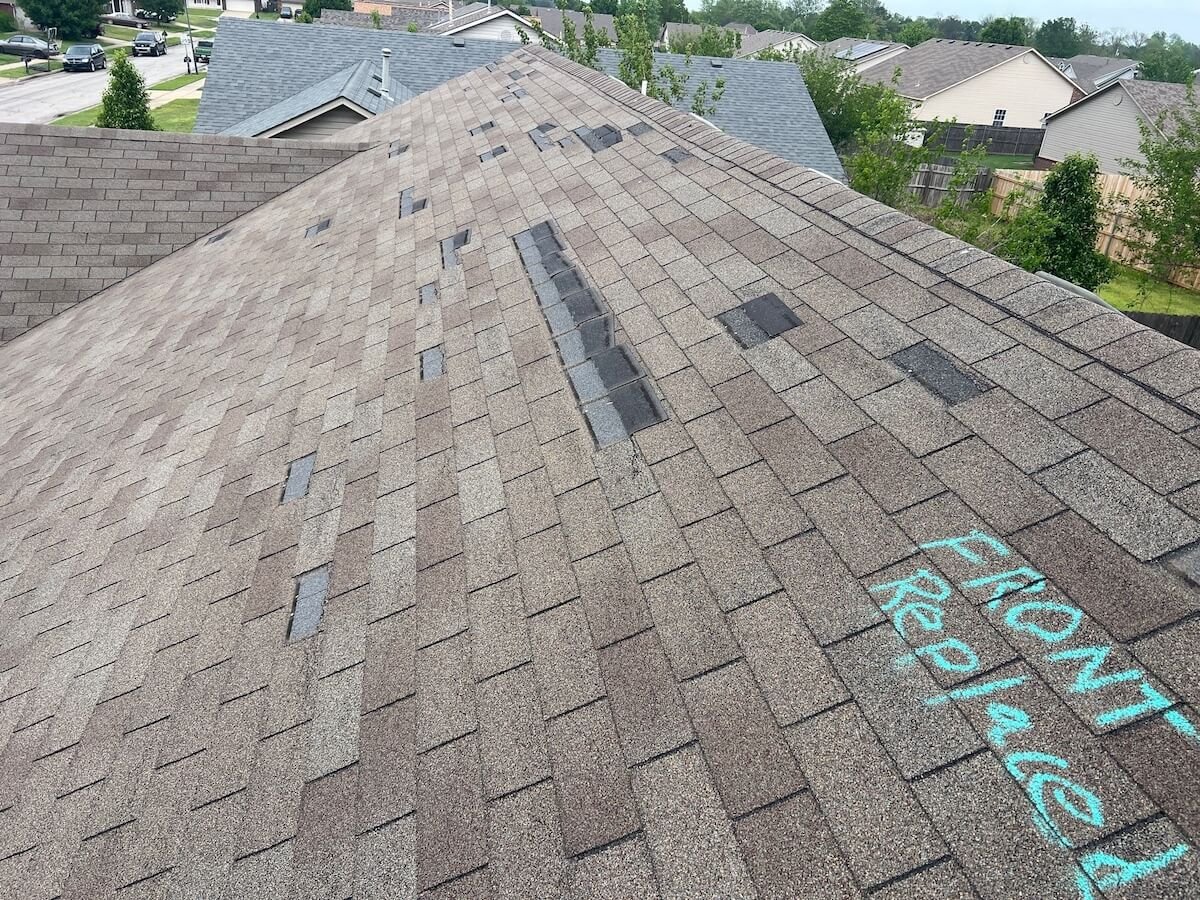
Some wind damage you can’t miss — shingles in the yard, half a roof gone. Most of it is hidden damage: broken adhesive seals (the mastic), loosened nails, damaged flashing, creases, cracks, a section worked loose. It won’t show from the ground — it takes a free roof walkthrough. Inside the house, check the attic and ceilings for new water stains.
The long version — Part 07 ↓What you can and can’t see from the ground
Wind damage isn’t consistent. Some shingles blow upward and lay back down. Some only crease or crack but don’t blow off. Unless shingles blew off, there may be no sign from ground level that a Tulsa wind storm did damage.
The long version — Part 08 ↓Insurance approval of wind damaged roofs
Hail damage is king for roof replacements in Tulsa — wind works differently. The number of wind damaged shingles determines if the roof is a candidate for replacement. If your insurance company recommends a wind damage roof repair, shingles that can’t be repaired or matched can turn it into a replacement.
The long version — Part 10 ↓Installation determines if your roof passes or fails
Roofs should be inspected during installation. Why? Human nature. Is it cold or hot? A steep, hard job? Human nature is to rush or cut corners. Nail placement is key to surviving a wind storm as the roof ages.
The long version — Part 09 ↓The best shingles for Oklahoma wind
Shingle manufacturers are in a race to the top on wind warranties. Fit your budget first — but 115 mph is the minimum warranty worth having, and 130 is the middle ground. The Atlas StormMaster Shake is our recommendation at 150.
The long version — Part 12 ↓Preventing wind damage to your Tulsa home
Over the years, severe weather in Tulsa seems to be on the rise — and so does its intensity. I used to say, “You’re one more storm away from needing a new roof.” I don’t say that anymore. Now it seems like if you have an older roof, you’re better off with a roof replacement compared to testing it to see if it can handle one more storm.
Lately there’s been a pattern: the homes survive the wind storm, but the major damage comes from falling trees and limbs. Here’s how I would prevent my own home from wind damage.
Start with the trees
Trees do a good job providing shade — other than that, they’re destructive to the home. My opinion: remove any tree around the house that has the reach to hit and damage your home.
Get the free roof walkthrough
If you have an aging roof, have it inspected at a bare minimum and fix the issues that are found. A professional walkthrough can also tell you when you DON’T have enough damage — which avoids an unnecessary insurance claim. But if your roof has a history of blown-off shingles, I would strongly lead you into replacing that roof.
Replace loose, damaged, or rotten siding
Wind doesn’t test the whole house — it tests the weak point. On siding, that’s the loose, damaged, or rotten piece. Inspect all of it — repair the damage if possible, or replace.
Tighten what wind grabs
Go around the entire property and make a list. Is there an overgrown bush or small tree rubbing up against the house? A loose or clogged gutter? Make the list, then start cleaning up those loose ends.
Secure the yard — your neighbors will thank you
Make the same list. Go around the property — what’s secured, what’s not? Or how about a better storing plan: maybe along the side of the house that’s protected from the wind. Those trampolines seem to always go flying.
What to do after a wind storm
The severity of the wind storm will factor into what you do — a tornado versus straight-line winds versus 50 mph winds. Here’s our list of what you should do, within reason.
1 Make sure the family is safe
Wind damage will range in severity, but family is first — confirm everyone is safe and in a safe location. Property is always secondary and can always get repaired.
2 Confirm the storm is completely done
Often one storm is followed by another storm, then another. Other times a big storm comes through and it’s blue skies after. Good practice: confirm the storms are completely done before going outside.
3 Inspect the property
Take a thorough look as you walk the property. Unfortunately, sometimes you don’t have to look that hard to see the damage. What you’re doing is evaluating your next steps: do you need to call the fire department — or Uncle Frank to help clean up?
4 Stay off the roof
There have been many times in my life I attempted things I shouldn’t have even attempted. Getting up on your roof may seem like a good idea — I assure you it’s not. Almost always, leaving things to the professionals is a good thing.
5 Photograph first, clean up second
Photos of the storm damage — and proof of the storm — may come in handy. An insurance adjuster may read an item you say is damaged as normal wear and tear. But if you have a photo, or 50 photos, the adjuster has proof of what the storm did — and may reconsider.
6 Schedule a contractor for temporary repairs
Wind damage can cause major damage that needs addressing right away — sometimes emergency tarping — to prevent further damage. Tarping to prevent further damage is often covered by insurance — keep the receipt. Even if you can’t tell the roof is damaged, making the call could save you a leak — we’ve seen two misplaced shingles cause one.
7 Look for leaks inside the home
We understand if you can’t tell the roof is damaged. But look at every corner of the house, and in every closet — even the ones you don’t want to go in. An interior leak — water damage showing up inside — could be what tells you there’s a problem.
8 Confirm your insurance policy
Instead of filing a claim and waiting on an adjuster to estimate the damage — only to find out the policy covered less than expected — confirm the policy first. It can save you from a claim on your record when you should’ve just repaired the damage.
9 Confirm all of the damage
After a storm, things can seem messy and stressful. Once you’ve taken all the photos and cleaned up, a full walkthrough of all the storm damage should be confirmed. If there’s plenty of damage to file a claim, okay — and if not, shoot, that’s okay too.
10 File a claim
Once the dust settles, the policy is confirmed, and the damage is clear, filing a claim is the next decision — and it’s always yours. Sometimes you just have to. That’s what the yearly premiums are for. And shoot — that’s Tulsa’s crazy weather for you. Before you file, run your numbers — deductible, code coverage, out-of-pocket.
What NOT to do after a wind storm
High winds can and will turn a normal situation into a chaotic one. In a matter of minutes, trees are down, power is out — and maybe it’s raining on the inside of your home. We have seen it all. This whole page exists to give Tulsa homeowners a calm, calculated response. Here is our don’t-do list.
1Don’t panic
Storms happen at the worst possible time — midnight, usually. Adding extra stress doesn’t help. I know — easier said than done.
Planning ahead? Put together a storm plan: extra food, water, batteries, and where you’d go if there’s a major problem.
2Don’t make rushed decisions
After a storm, even a couple of missing shingles may be stressful — let alone a tree through the house. What we want to avoid is the rushed decision, like hiring a contractor you have bad feelings about.
Planning ahead? Have contractors already lined up — roofing, tree, fence.
3Don’t go near downed power lines
Every year you hear the warnings about power lines on the TV or radio. They’re true — power lines are dangerous. If you see one down in the road or in the backyard, just stay away.
Planning ahead? If power lines cross your backyard, my opinion is remove the trees near them completely — or have them trimmed and confirmed healthy.
4Don’t just start cleaning everything up
We all know your yards are award-winning — not even one weed. Haha. But please don’t start cleaning things up. The mess is evidence of the storm and the damage it might have done. A small limb landed on the grill? Take a picture. Evidence helps and proves your claim.
Planning ahead? List everything outside — grill included — and photograph its condition now. When a storm comes, you’ll know the old dents from the new.
5Don’t assume the roof is fine
We’ve personally seen a small hole from a tree limb cause a leak in a home. This isn’t to scare you into a roof walkthrough — it’s to keep even the smallest wind damage from becoming a leak.
Planning ahead? Proper maintenance to the roof — and replacement when it’s time — can and will keep the small and sometimes catastrophic issues from happening.
6Don’t attempt work you don’t normally do
We’ve all watched those online videos — the ladder, the chainsaw, the moment it goes wrong. The tree on the roof, the hanging limb, the DIY patch: is it worth it? Maybe. Not if you get hurt. The professionals do this daily — let them.
Planning ahead? Keep the contractor list handy — and stay ahead of maintenance year-round: the roof, the trees, the yard.
7Don’t tarp more than the damage
A few blown-off shingles, a small hole — and a contractor covers it with a 10×10 tarp. We’ve seen it plenty. Whether insurance covers that extra tarp damage varies; when it doesn’t, every nail-holed shingle is yours to fix, not just the original couple.
Planning ahead? The broken record plays again: maintain the roof, replace it when it’s time, secure the property. The neighbor’s trees, unfortunately, are out of your hands.
8Don’t sign a contract you haven’t read
There’s nothing wrong with signing an insurance contingency contract before any work starts. The problem comes when the company hasn’t been fully vetted and the contract hasn’t been read. Canceling after the cancellation window may cost you part of the claim.
Planning ahead? After a storm you’ll feel pressure to sign with the first knock on the door. Before the storm is the time to interview contractors, do the research, and have a couple you’d trust ready to call.
9Don’t automatically file a claim
Not all damage is the same, and not all insurance policies are the same. Things can look like a disaster — and with roofing signs in every yard, it can feel like everyone’s filing — but I guarantee the outcomes are not all the same. Confirm the policy, confirm the damage.
Planning ahead? Confirm the right insurance policy is in place — an RCV policy with a low deductible and building code coverage is a good start. Then all that’s left after a storm is confirming the damage.

What wind speed damages a roof in Tulsa?
The wind speeds on this ladder come from the National Weather Service’s own scales — the Beaufort scale on the low rungs, the Enhanced Fujita scale on the high ones. The what-could-happen column is ours, from the wind damage we’ve seen on Tulsa roofs. Drag the wind up — or press a rung.
| Wind speed | What Tulsa calls it | What could happen to your home |
|---|---|---|
| 32–46 mph | A windy day — wind advisory territory | Older roofs start having problems here — a shingle or two, a small section, ridge caps. |
| 47–54 mph | Damaging winds — slight structural damage can start here | Secondary items become problems — tree limbs, debris blowing around the house, old roofs needing replacement. |
| 55–63 mph | Severe thunderstorm winds — 58 is the official line | Whole trees can come down, anything unsecured moves — wind finds a newer roof’s weak points. |
| 65–85 mph | EF-0 winds — the strongest straight-line winds live here too | I’ve seen trees broke in half, siding blown off — wind damaged roofs become more severe. |
| 86–110 mph | EF-1 winds — derecho territory | Well-built roofs can still hold here. Others can’t — and falling trees become the big problem. |
| 111–135 mph | EF-2 | Large sections of roof structure come off — real structural damage. The 2017 midtown tornado was an EF-2. |
| 136+ mph | EF-3 to EF-5 | We all know the catastrophic tornado damage these can cause. Have a plan in place. |
How wind uplift takes a roof apart
Wind uplift is the suction created as wind flows up and over a roof — strongest at the corners and edges of the roofline. When high winds are beating up against your house and roof, they aren’t going to tear off the shingle that’s properly nailed and sealed. They’re going to find the weakest point and start working on it — the area that never sealed properly, or the shingle nailed higher than it should be.
The seams
The vertical seams of the shingle are where two shingles butt together. Very rare for wind damage to happen in the middle of the shingle. What happens is wind catches the corner of the shingle and either loosens the shingle or rips part or the entire shingle off the roof.
The slow damage — We’ve noticed wind pulls the corners of the shingle upward — the seal pulls apart, but nothing blows off or cracks.
The extreme damage — When the seams completely fail, you will see a diagonal line of shingles blown off the roof.
The seals
The seal is what’s called mastic — a sealant strip, or strips, that bond each shingle to the one below it. How wind affects the seals has a ton of variation: wind can completely break or separate them, and winter installs and low-quality shingles help it along.
The slow damage — Think of peeling an orange — a little at a time, a little here or there. Same for the seals: a little updraft, a little wiggle, and slowly they weaken.
The extreme damage — An older roof or a new-construction roof, plus the right gust — multiple areas blown off on each section.
The nails
The nail is what secures the shingle to the roof. Nails out of place — even off just a little — give the shingle space to flex. And a nail overdriven too far in, or underdriven and sticking up instead of flush: each issue gives wind a weak point to access.
The slow damage — Shingles loosen and crack as wind pulls them upward. A creased shingle is a shingle the wind bent backward but didn’t blow off. Haag Engineering — the company that wrote the walkthrough standard — classifies a creased shingle as wind damage even when it lies back flat.
The extreme damage — Nailing issues cause a variety of damage — including shingles consistently blowing off each time the wind blows.
Can you see wind damage from the ground?
Roof shapes and sizes are rarely the same here in Tulsa, so what you can and can’t see from the ground will vary. Looking at the roof from the ground and saying “I think we’re good” comes with risk when it comes to wind damage — here’s why.
What you can see from the ground
Sorry, but we have to start off with a little joke — we get quite a few calls saying, “We have shingles in the yard, but we don’t know if they’re ours or the neighbor’s.” If you’re not a roofer, sure, you’re going to wonder — but you’re limited to what you can and can’t see. Writing this, all I can think about is the variance wind damage causes. I think about the visible damage — a large section of blown-off shingles obvious to the naked eye — but then a couple of missing shingles on the back second story that you can’t see from the ground.
What you can’t see from the ground
Most wind damage is hidden damage — you can’t see it from the ground: mastic separation, nails pulled through the edge of the shingle, lifted shingles, loose shingles, cracked and damaged shingles, as well as creased shingles. On many — and I mean many — occasions, shingles will be blowing up and down during the windstorm, then the winds stop and the shingles lay right back down. This is why a storm damaged roof must be inspected — not just assumed to look good.
Installation errors that wind damage finds
Even though we strive to install the best roof possible, I don’t think there’s a perfect roof out there — one where every nail is perfectly installed. With that being said, I do think our industry has big issues when it comes to storing shingles and installing shingles.
Distributor storage and delivery issues
Most asphalt shingles are stored outside, sitting there from months to years. The roofing materials get rained on, the dust blows, and the plastic on the shingles gets worn off — so the rain and dust start getting on the shingle itself. The second issue is delivery of old shingles. Each time we had 3-year-old shingles delivered, there was some type of problem. We don’t accept anything older than 2 years. The more dust and dirt on the shingle, the less likely it seals perfectly.
No supervision
The roofing contractor shows up in the morning to get the crew started, then the next time you see him is when he comes to pick up the check. What happened in between? Nobody knows. Was the nailing pattern correct? Once the shingles are down, none of that can be inspected.
New construction
Homes are built year-round, and all the dirt swirling around a job site attaches to the sealant strips, preventing shingles from ever bonding properly. Shingles start blowing off around year 12. How do I know? I live in a new construction subdivision in Tulsa — each time the wind blows, it’s easy to find work.
Cold weather installs
Manufacturers recommend installing roofs in temperatures no lower than 40 degrees. For a shingle to seal properly, it needs warm air and heat from the sun. Without that heat, the mastic strip doesn’t attach — shingles end up sitting on top of each other instead of sealing down. Then the unsealed strips collect dirt and dust, and when it finally warms up, the seal can’t do its job. That’s why winter storms tend to catch these roofs first — the shingles never sealed.
When does insurance approve a wind damaged roof?
Wind damage roof claims in Tulsa can and will have a lot of variety and volatility. Why? Insurance companies react to wind damage differently than hail damage, and so do adjusters — that’s the human aspect. And the damage itself varies: one slope can lose quite a bit of shingle while the other sides are fine, or the damage is creased shingles instead of missing ones. Honestly, there’s no one-size-fits-all scenario.
Conditions for replacement under homeowners insurance
For a roof to be approved for a full roof replacement through your homeowners insurance, you’re going to need a percentage of the roof damaged by a wind storm — and that percentage is completely dependent on the insurance company. For example only — an insurance company may require 25% of the roof to be damaged for replacement. I can’t say it’s 25 percent or 40 percent. I do know you’ll need quite a bit of damage, on many slopes, to be a candidate for replacement. Wind damaged roofs in many cases start as a partial repair — unless the damage exceeds the insurance company’s standards for a full roof replacement.
A suggested repair can still turn into a replacement
In regards to an insurance claim, a couple of things are going to direct the claim. The first is your policy — and that’s between you and your agent. The other factors are the facts of the damage, the method of repair, and the availability of the product needed.
Facts of the damage — Wind damage has many variations — but let’s say only 5 blown-off shingles were accounted for. Then a walkthrough happens, and many other shingles were loose or creased. Finding additional damage could convert a repair into a replacement.
Method of repair — Are the shingles repairable? We attempt to repair the wind damaged roof, but we damage two additional shingles. Then repairing those two, we damage two more. If the roof is not repairable, that becomes an issue. Second, building-code-related issues: decking issues or saturated decking can enlarge the repair, which might put the repair into replacement.
Material availability — If the shingles are not available — maybe by color or size — this would be another fact worth considering a replacement instead of repairs.
If you are only moved by the facts — and let the facts determine the direction a claim goes — then you have some possibility of turning a repair into a replacement.
The full claims playbook — the five policy factors, the ten-step process, picking a contractor — lives on our Insurance Claims page.
How to get a good roof installation
This is not to toot my own horn or in any way to boast about myself. My career started in 1996, and I have installed thousands of roofs and have worked with a ton of different people in my career. Roofing is hard work, and more than ever I’m convinced that perfect roofing weather only happens a small percentage of the time — so human nature is to take shortcuts.
1Ask questions
The reason we write pages like this — and the blogs — is to give you the information so you can ask questions, and the right questions. When you’re meeting with contractors, ask questions. Do they know the answer, or need to get back with you? Every stage of the process, learn a little more and keep asking. Eventually you’ll see if the roofer knows the answers — and if not, maybe that’s a sign he’s not the one. Same with install day: be out there when they’re setting up tarps. Shoot, pull up a chair. It’s your money and your roof — you might be the only one paying attention.
2The weather will change
Installing roofs in weather below 50 degrees — or on a cloudy day — the shingles may not seal that day. If you have to because of a leaky roof, then you have to. Same on the other side: 100 degree weather with a 118 heat index is tough. If you have to, you have to. We have done both. But if you’re not in a rush, wait a couple days or a week.
3Be available — don’t just go to work
Personally, we have been in every stage of life — the newborn baby at home, and the stage where everything is breaking down, including my new work truck. But being home and double-checking the work is key. Roofing contractors aren’t used to Tulsa homeowners being part of the process — most of the time no one is around, and that’s exactly why things aren’t always done correctly. You being present changes that. Can’t take the day off? No problem. Ask for lots of photos. Check in on a lunch break. Call if something looks off.
4Check the delivery
When the materials arrive, inspect the pallets. These are your shingles — you’re paying for them. Look at the condition of the packaging. Each shingle has a manufacture date on the back. Check the date. If those shingles are more than two years old, address it with your contractor. Also look for worn shingles, or shingles not in their packages. If you wouldn’t put those shingles in your cart at the store, don’t let them go on the roof. Don’t be shy about it.
5The on-site supervisor
I think this is by far the most important. The only way to make sure the work is done properly is an on-site supervisor checking the work during the install. Ask if the roofing contractor has an on-site inspector who inspects the work during the process and not after. Listen closely as you ask this question. It could tell you everything.
6The decking
If you’re at home — or getting photos sent — the roof decking is the thing to watch. Check every piece of plywood for stains, sagginess, or pieces that need nailed down. Shingles are only as good as the surface they’re nailed to. It all starts with the decking.
7Six nails, not four
We don’t recommend 4 nails per shingle. The 4-nail install is a super fast practice that excludes proper placement and increases the likelihood of blow-throughs. If one nail were to fail, you’ve lost 25% of the shingle’s holding power. Installing 6 nails per shingle is how you get a higher-rated wind warranty through most shingle manufacturers.
The best shingles for Oklahoma wind
There are factors that help guard Tulsa roofs against wind damage — some more important than others. I’m going to describe mostly the Atlas brand of shingles that we sell. Not to get you to buy them, but to teach — and to describe why we highlight them in regards to wind resistance. Here are the characteristics that I find important.
Fewer shingles per roof
The Atlas shingle is the largest shingle on the market, which requires 8 less shingles per 10'x10' area compared to other shingles.
The common bond area, or the nail zone
The common bond area is where the two parts of the shingle overlap — it’s also the nail zone. Atlas overlaps 1-1/2 inches, one of the largest if not the largest, guaranteeing that every nail hits two layers of shingle. Other shingles with a nailing strip still only get nailed into one layer.
The sealant strip
The sealant strip is what holds each shingle to the other. Once that warm sun warms them up, the shingles stick to one another — which prevents wind uplift from prying the shingle loose. Atlas shingles have two rows of sealant compared to the standard one row. Even the starter shingle has two rows.
We’re using Atlas as the example, but you can see the many levels of design that help resist wind damage. The question is: the shingle you’re thinking of — does it have one benefit against wind damage, or three?
The two best wind-resistant shingles we install
Both are great shingles, backed by solid companies with great local reps — and that matters when something goes wrong. To be completely transparent — we installed the CertainTeed Northgate shingle on my mom’s house. What I like about both is the additional granular adhesion: when you walk on these shingles, it’s like walking on sandpaper — your shoes grip. The 150 and 160 mph warranties are the top of the range, and they have requirements from the manufacturer: 6 nails per shingle, and you must use the manufacturer’s starter shingles and ridge cap shingles.
warranty
Atlas StormMaster Shake
The Atlas brand already holds reliable traits against wind damage — the largest shingle on the market, and the largest nail zone, where you’re always nailing through 2 layers of shingle so the nails hold better. On top of that, the StormMaster Shake has a wind warranty of 150 mph.
warranty
CertainTeed Northgate ClimateFlex
It comes in 4 bundles per square compared to the standard 3, and it weighs more than 20 lbs more per 10'x10' area. But what makes the Northgate one of the very best is the required install: the seams must be staggered. Staggering the seams prevents one blown-off shingle from taking the 10 above it in a diagonal. Heavier shingle, staggered seams — two great combinations.
6 nails per shingle required Manufacturer’s starter shingles Manufacturer’s ridge cap shingles
Wind damage FAQ
I found shingles in my yard — not sure if they’re mine. What should I do?
Start with the shingle itself — does the shape and style line up with yours? Then a slow walk around the house: look for lifted shingles or missing shingles. Can’t tell, or found a problem area? Have the roof inspected. Do what you can without getting on the roof, then make a call.
My roof looks fine from the ground. Can it still have wind damage?
The short answer is yes. Wind damage isn’t only blown-off shingles — shingles get loosened, slightly out of place. That kind you can’t see from the ground, so it gets missed — wind driven rain finds it, and over time, a leak. If it looks good, confirm with a professional walkthrough. Then you can rest until the next storm.
How strong does wind have to be to cause roof damage?
A roof already experiencing issues could have problems in 30–40 mph wind. A 1-year-old roof could take 100 mph wind — like the derecho that came through — and have no damage. So I’m less concerned with the wind speed and more concerned with the condition of your roof. My advice: get that old roof replaced as soon as possible.
Do I need a roof walkthrough after every windstorm?
No — not after every storm. A yearly walkthrough? Absolutely, if your roof is on the older side of its lifespan. And after back-to-back severe storms, a close tornado, or severe weather, a walkthrough is realistic. Each one helps you gauge how often the roof should be looked at.
Why did MY roof lose shingles when the neighbors’ didn’t?
Usually it’s one of four things: roof age, more direct wind with less protection, a better shingle or installation on their side, or a winter install on new construction. Maybe your roof has one of these issues, maybe all of them — that’s why yours failed and theirs didn’t.
Should I tarp wind damaged shingles?
The short answer is yes — tarp wind damaged shingles, especially blown-off shingles. Two things to consider: if you might file a claim and the repair may take time, emergency tarping is the right move — but don’t over-tarp, just the damaged section. If you’re repairing right away, maybe a quick repair means no tarp at all.
What is the best shingle to guard against wind damage?
The two top shingles we sell for Tulsa roofs are the Atlas StormMaster Shake and the CertainTeed Northgate ClimateFlex — 150 and 160 mph wind warranties. Which one comes down to your budget.
Do you charge for a wind damage walkthrough?
We do not charge for a wind damage walkthrough. If you have damage, we document it with a photo report — which is provided to you. If there’s no damage, we’ll gladly tell you so, and you can have peace of mind.